New York City
Memoirs of a GeishaNew York City is the setting of Sayuri’s later life and chosen departure from Gion: a place she initially approaches as an unfamiliar world of immense buildings and bright possibilities, then makes her home through a small teahouse, Japanese friendships, and years spent with the Chairman. Its significance lies not simply in providing refuge from the limits of her former profession. From across the ocean, Sayuri can establish a life of her own, while the city’s changing streets and her recollections of Gion give the novel a final perspective on belonging, survival, and loss.
First Encounters and the American Journey
Sayuri’s relationship with New York City begins on her second journey to the United States with the Chairman in the fall of 1952. She travels by rail alone to Tokyo and flies from there with him to Hawaii, where he buys her a bathing suit, her first. After several days, they continue to Los Angeles and then New York. Because she has known the United States only through films, the city’s scale initially seems almost beyond belief. From her room at the Waldorf-Astoria Hotel, she looks at the mountainous buildings and smooth, clean streets below and feels she has entered a world where anything might be possible.
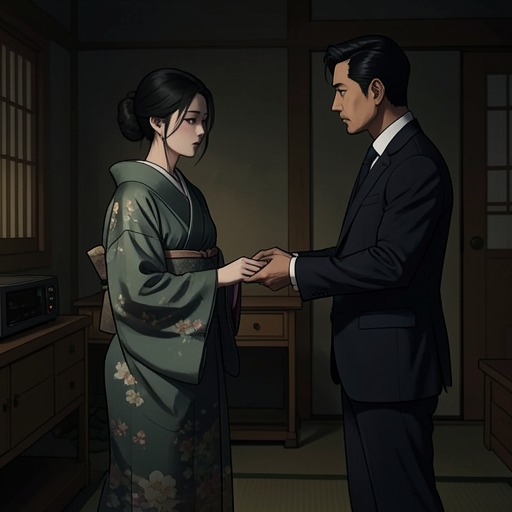
The arrival is not only an encounter with urban spectacle but also a test of how far the unfamiliar can become habitable. Sayuri expects that leaving Japan will make her feel like a baby taken from its mother; instead, the Chairman’s enthusiasm helps her approach the visit with goodwill. He keeps a separate room for business but spends each night in the suite arranged for her. Sometimes she wakes to find him sitting by the window, holding back the sheer curtain and looking down Park Avenue. Once, after two in the morning, he takes her by the hand to watch a young couple in formal clothes kissing beneath a street lamp. The city becomes part of their shared private life, not just a distant field of American marvels.
A Familiar Social World Abroad
Over the next three years, Sayuri travels with the Chairman to the United States twice more. While he conducts business, she and her maid visit museums and restaurants, and she attends a ballet that leaves her breathless. A Japanese restaurant in New York brings a more direct return of the past: its chef is someone she knew well in Gion before the war. In his private back room, she entertains men she has not seen for years, including the vice president of Nippon Telephone & Telegraph, Japan’s new Consul-General, formerly mayor of Kobe, and a political science professor from Kyoto University. For a moment, the room feels almost like Gion again. New York is foreign, yet Japanese professional and social networks let Sayuri recognize part of her old world within it.
That recognition also reframes what it means for her to live abroad. By the time she is considering a permanent move, Japanese businessmen and politicians are regularly arriving in New York, and many are already familiar to her. She sees an opportunity to serve a community whose members cross the same distance she is preparing to cross herself. The city’s connection to her former life is therefore practical as well as emotional: it can sustain the work and company she knows, even when she can no longer return to her old place in Gion.
Departure and the Teahouse
In 1956, as the Chairman spends more time in the United States and plans to open a branch of his company there, Sayuri raises the possibility of establishing a small teahouse in New York. She knows she cannot resume work in Gion, but the prospect of welcoming Japanese visitors gives her another way to continue entertaining. The Chairman initially resists the idea of her leaving Japan. Sayuri’s proposal also carries a consequence for his family: her departure would remove the obstacle to adopting Nishioka Minoru as his heir. When the Chairman understands what she is suggesting, his startled expression gives way to visible distress at the thought of her leaving.
In August of that year, Sayuri moves to New York City and opens a small teahouse for Japanese businessmen and politicians traveling through the United States. Mother tries to make the new business an extension of the Nitta okiya, but the Chairman refuses. Mother’s authority over Sayuri has depended on her remaining in Gion; leaving breaks that control. The Chairman sends two accountants to ensure that Mother gives Sayuri every yen due to her, making the move an economic separation as well as a change of address.
Sayuri’s first apartment door closing behind her at the Waldorf Towers brings fear, but New York soon feels at least as much like home as Gion. Her teahouse occupies the second floor of an old club off Fifth Avenue and is modestly successful from the beginning. Geisha come from Gion to work there, and Mameha sometimes visits. Sayuri herself later attends only when close friends or old acquaintances are in town. The establishment thus provides work and a meeting place without requiring her to recreate her former life exactly.
Work, Memory, and a Changing Gion
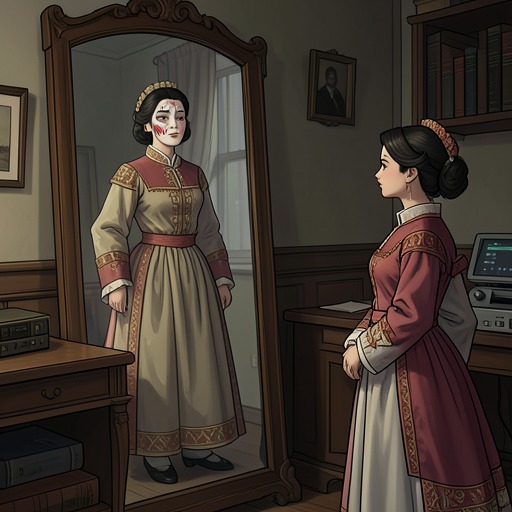
Sayuri’s daily life in New York broadens beyond the teahouse. In the mornings, she joins Japanese writers and artists from the area to study subjects including poetry, music, and, in one month-long session, the history of New York City. She lunches with a friend most days. In the afternoons, she prepares for parties at her makeup stand, sometimes in her own apartment. Raising the brocade cover on her mirror recalls the milky odor of the white makeup she wore in Gion: a domestic gesture in New York opens directly onto the sensory memory of her earlier career.
She wishes she could visit Gion, but fears being disturbed by how much has changed. Photographs brought back from Kyoto make the district seem thinned out, like a neglected garden overtaken by weeds. After Mother’s death, the Nitta okiya is torn down; a small concrete building with a bookshop below and two apartments above replaces it. The contrast between a vanished household and the modest new structure makes change legible in the city she left behind. New York is not an unchanged refuge; it is where Sayuri lives as she watches her former home recede through other people’s photographs and her own memory.
The scale of that loss is expressed in Gion’s dwindling population. Eight hundred geisha worked there when Sayuri first arrived; now fewer than sixty remain, with only a handful of apprentices, and the number continues to fall. Against this contraction, her New York teahouse sustains a smaller, mobile connection to the community: some geisha travel from Gion to work there, and Mameha still comes to visit. The city does not restore the old district, but it allows some of its relationships and practices to continue elsewhere.
The City as Home and Vantage Point
On one of the Chairman’s last visits, he and Sayuri walk through Central Park. Among the pine trees, he stops with his hands resting on his cane and his eyes closed, remembering the pines along the street where he grew up outside Osaka. In New York, the past becomes present in an unfamiliar landscape: the trees draw the Chairman back toward the place and life he remembers. Sayuri, who has spent years learning to inhabit the city, sees how memory can make another place feel more real than what is before the eyes.
The same double vision shapes her final assessment of New York. Crossing Park Avenue, she can feel how exotic its yellow taxicabs and briefcase-carrying pedestrians appear to a small Japanese woman in kimono. Yet she no longer assumes that Yoroido would feel any less exotic if she returned. The city has become home without ceasing to be strange; the place she once thought of as home has become distant without losing its hold on her. New York City thus stands at the end of Sayuri’s story as both a real setting of work and companionship and a measure of how time alters every place a person calls home.